Kemeloi, a rural township in Kenya’s North Rift region, is
witnessing a social and economic transformation.
Sallie Lukuyu, the Principal of Aldai Technical Training
Institute (ATTI), says it started with the elevation of the once laid-back
village polytechnic to a technical institute offering wide-ranging courses and
admitting students from across the wider North Rift region.
“We have opened up what used to be a remote location in
Kemeloi. The benefits of expanding the institute’s capacity through the
expansion of infrastructure, new courses and more students are clear. The large
student community means more economic activity in the location,” Lukuyu said.
The African Development Bank is supporting the expansion of
Technical and Vocational Education and Training (TVET) in Kenya and other 20
African countries. The programme focuses on improving the quality of
educational facilities in technical institutions, including the expansion of
infrastructure and provision of necessary equipment.
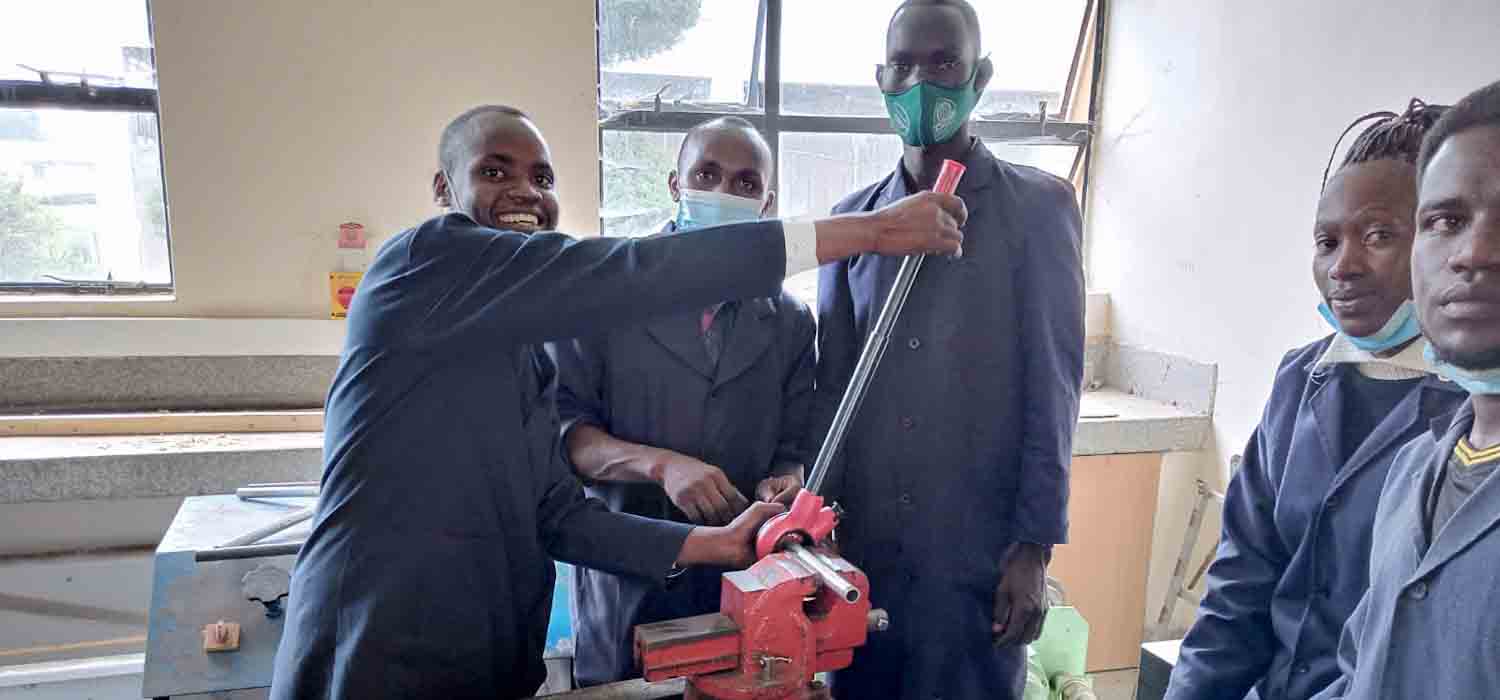
At the Aldai TTI, the Bank provided funding for increasing
lecture halls, putting up a civil engineering training complex, and acquiring
equipment. This enabled the institute to more than double its training
programmes.
A similar development is being witnessed in Tsavo East, near
Voi town in south-east Kenya, at the coast.
Stephen Ngome, the Principal of Coast Institute of
Technology (CIT) appreciates the Bank for enabling the institution to build
Sapphire Hotel, which now provides practical training to students pursuing
careers in hospitality and tourism. In Kenya, tourism is a leading contributor
to the gross domestic product (GDP).
“We are seeing growth. The hands-on experience has given us
confidence in the graduates we churn out to the hospitality sector. The skills
we are providing are demand-driven. We have grown to become a centre of
excellence in tourism. The support we have been receiving from the Bank have
enabled us to train 770 students. These students have spread their services across
Kenya,” said Ngome.
Bruno Wanyama, the Deputy Head of the Department of
Electrical and Electronics, added: “Through the Bank’s support, CIT has been
able to construct an electrical and electronic engineering laboratory. The lab,
completed in 2018, helps to train students in ICT, general hotel maintenance,
hospital facility management and telecommunication engineering.”
Since 2015 when the African Development Bank completed the
first phase of the project to improve TVET in Kenya, Aldai TTI has introduced
13 new courses and graduated 234 students, 170 of whom re self-employed, while
34 are pursuing advanced training.
Jonah Koech, a student who graduated from Aldai TTI in
February 2021, obtaining a Certificate in Building Technology, which covers
mechanical engineering, plumbing and wall construction, says the availability
of equipment and the training provided courtesy of the African Development Bank
has made a difference in the township and beyond. Technical talent is now more
available.
“Fellow graduates of the institute are expanding services
such as electrical engineering, carpentry, and brick-making, to neighbouring
towns,” he said.
Wilfred Kurgat, who graduated from the institution three
years ago, has started an electronics workshop, where he repairs televisions,
watches, phones and anything electronic. He says the knowledge and skills he
received from the institution has enabled him to earn a living. “I am now able
to make money and pay my bills from this business, as well as support my parents.
I am happy that I have become self-reliant,” he said.
The institute has also opened a new soil-testing laboratory,
which is helping to train agronomists and providing the farming community with
technical expertise to improve farm yields.
In the Bank’s second phase of financing for TVETs, Aldai TTI
has constructed an ICT complex, which has enabled it to double enrolment in ICT
courses from 85 students to 186.
Upgrading the institution has enhanced the business
environment in the area. Hostels and houses have sprouted to provide
accommodation to students and workers. Wilfred Langat, an entrepreneur in
Kameloi, has invested in the property business, which is enabling the institute
to provide boarding facilities to some 162 students.
In Kenya, the demand for technical education has been
increasing as more school leavers opt for technical education because jobs in
the sector, especially at low to mid-level, are more available than in other
fields.
Kenya’s Director of Technical Education, Tom Mulati, says
this is evident in the 6,667 students who qualified to join university this
year, opting for mid-level TVET education. This number has always been
much lower. “Therefore, the perception is changing,” he stresses. “It is all
about the equipment. It is all about how we are also changing the curriculum so
that it is developed by the industry, such that the skills produced are very
relevant to the market.”